Date: 1972
Description: Edith Campbell spreading the cooked Huckleberries onto the racks. These scenes of food processing were initiated in order to fill some of the gaps left by earlier anthropologist and cultural observers among the Gitxsan. The objective was to create colour images of practices that were partially captured in earlier black and white photographs and in early texts such as those written by Marius Barbeau and William Beynon. The Book Builders of 'Ksan produced a volume on these collecting and…
Date: 1972
Description: Edith Campbell spreading berries on to drying racks. The gitxsan name for huckleberries is sim maa'y, meaning ""the real, the true berry"". They are the favored berry for drying as they retain their flavour well, and are easy to roll when dry These scenes of food processing were initiated in order to create colour images of practices that were partially captured in earlier black and white photographs and in early texts such as those written by Marius Barbeau and William Beynon. The Book…
Date: 1972
Description: Edith Campbell spreading the cooked Huckleberries onto the racks. These scenes of food processing were initiated in order to fill some of the gaps left by earlier anthropologist and cultural observers among the Gitxsan. The objective was to create colour images of practices that were partially captured in earlier black and white photographs and in early texts such as those written by Marius Barbeau and William Beynon. The Book Builders of 'Ksan produced a volume on these collecting and…
Date: 1972
Description: Edith Campbell spreading the cooked Huckleberries onto the racks. These scenes of food processing were initiated in order to fill some of the gaps left by earlier anthropologist and cultural observers among the Gitxsan. The objective was to create colour images of practices that were partially captured in earlier black and white photographs and in early texts such as those written by Marius Barbeau and William Beynon. The Book Builders of 'Ksan produced a volume on these collecting and…
Date: 1972
Description: Edith Campbell spreading crushed huckelberries on drying rack. The prepared berries have been spread out over a bed of salmonberry leaves. Skunk cabbage is normally used for this purpose. These scenes of food processing were initiated in order to fill some of the gaps left by earlier anthropologist and cultural observers among the Gitxsan. The Book Builders of 'Ksan produced a volume on these collecting and processing practices titled Gathering what the Great Nature provided: food traditions of…
Date: 1972
Description: Edith Campbell spreading the cooked huckleberries onto the racks. These scenes of food processing were initiated in order to fill some of the gaps left by earlier anthropologist and cultural observers among the Gitxsan. The objective was to create colour images of practices that were partially captured in earlier black and white photographs and in early texts such as those written by Marius Barbeau and William Beynon. The Book Builders of 'Ksan produced a volume on these collecting and…
Date: 1972
Description: Edith Campbell spreading crushed huckelberries on drying rack. The prepared berries have been spread out over a bed of salmonberry leaves. Skunk cabbage is normally used for this purpose. These scenes of food processing were initiated in order to fill some of the gaps left by earlier anthropologist and cultural observers among the Gitxsan. The Book Builders of 'Ksan produced a volume on these collecting and processing practices titled Gathering what the Great Nature provided: food traditions of…
Date: 1972
Description: Edith Campbell spreading the cooked Huckleberries onto the racks. These scenes of food processing were initiated in order to fill some of the gaps left by earlier anthropologist and cultural observers among the Gitxsan. The objective was to create colour images of practices that were partially captured in earlier black and white photographs and in early texts such as those written by Marius Barbeau and William Beynon. The Book Builders of 'Ksan produced a volume on these collecting and…
Date: 1972
Description: Edith Campbell spreading salmonberry leaves on the drying racks. These scenes of food processing were initiated in order to fill some of the gaps left by earlier anthropologist and cultural observers among the Gitxsan. The Book Builders of 'Ksan produced a volume on these collecting and processing practices titled Gathering what the Great Nature provided: food traditions of the Gitksan, by the people of 'Ksan.
Description: Shaman's doll, carved and painted, adorned with fur as hair.
Date: 2008
Name(s): MacDonald, George F.
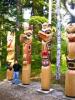
Description: Totem poles at Kitselas Canyon representing the four clans of the Gitselasu; the Wolf, the Eagle, the Raven and the Killer Whale. Carved by Stan Beven
Date: 1937
Name(s): Barbeau, Marius, 1883-1969
Description: This memorial pole depicts a grizzly bear with a plain column above its head. Squat figures of owls are carved in the ears of the bear. The pole appears in the photograph to be remarkably well preserved in relation to the others on the site and was probably erected just prior to the abandonment of the site.
Date: 1967
Name(s): MacDonald, George F.
Description: This memorial pole depicts a grizzly bear with a plain column above its head. Squat figures of owls are carved in the ears of the bear. The pole appears in the photograph to be remarkably well preserved in relation to the others on the site and was probably erected just prior to the abandonment of the site.
Date: 1910
Name(s): Newcombe, C. F. (Charles Frederick), 1851-1924
Description: This pole consists of a head of a Grizzly Bear at the top, with three large complete Grizzly Bears sitting erect along the pole to the bottom. In the background is the Pole of Sanaws.
Date: 1966
Name(s): De Menil, Adelaide
Description: Detail of a pole in Stanley park. In the early 1920s, the construction of an Indian village was proposed for the area near Lumberman©s Arch in Stanley Park. The site was chosen because it was located on a massive shell midden, or cultural mound that was the result of many years of Coast Salish habitation. This large deposit of calcified shells covered an area 8 feet deep and spanning several acres. The original poles were all from the Alert Bay area, but others were purchased from the islands…