

Search Content
Discarded Items from the Past
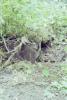
A photo taken during the survey and excavation of various village sites in the Kitselas Canyon. The collection consists of photos taken by Morris Mason, Dave Walker and Gary Coupland during archaeological surveys and digs in the early 1980s.
Rock Art
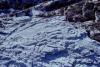
Petroglyphs at the Kitselas Canyon.These photos were taken by Morris Mason, Dave Walker and Gary Coupland during archaeological surveys and digs in the early 1980s
Rock art on Dry Island
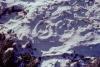
One of three faces of Dry Island. Many petroglyphs exist in the Kitselas Canyon area but they are difficult to date due to a lack of organic material. They were likely created for shamanic purposes. These Kitselas Canyon photos were taken by Morris Mason, Dave Walker and Gary Coupland during archaeological surveys and digs in the early 1980s
Face carved in the Stone

One of the three faces of Dry Island. From this perspective the face appears human. From the other side it appears animal. These photos were taken by Morris Mason, Dave Walker and Gary Coupland during archaeological surveys and digs in the early 1980s
Rock Art
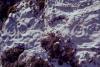
Faces carved in stone on Dry Island. These photos were taken by Morris Mason, Dave Walker and Gary Coupland during archaeological surveys and digs in the early 1980s
Kitselas Petroglyphs
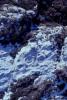
Faces carved from the stone on Dry Island. These photos were taken by Morris Mason, Dave Walker and Gary Coupland during archaeological surveys and digs in the early 1980s
Rubbing of Kitselas Rock Art
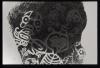
Rubbing of the 'Rescued Rock' of Ringbolt Island. Rubbing and photo by Dave Walker, 1972.
The Main Petroglyph on Ringbolt Island
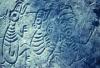
Main Glyph' of Ringbolt Island. Human style figures wearing crowns or head pieces.
Live Timber Harvest
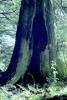
Culturally midified tree in the Kitselas area. This tree likely had its bark harvested at some time in the past.
Totem Pole at Visitor Centre
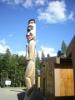
Visitor Centre at Kitselas Canyon 2008.
View of the Canyon
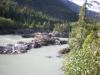
Ringbolt Island is th location of five seperate petroglyphs. It is most likely that the petroglyphs in the Kitselas Canyon are associated with shamanism. A shaman is a religious specialist and healer whose primary function is to cure people. Shamanic activity was carried out away from village sites and is very closely associated with notioins of transformation.
Ringbolt Island in the Kitselas Canyon

Ringbolt Island is the location of five seperate petroglyphs. It is most likely that the petroglyphs in the Kitselas Canyon aree associated with shamanism. A shaman is a religious specialist and healer whose primary function is to cure people. Shamanic activity was carried out away from village sites and was very closely associated with notioins of transformation.
View of the Skeena River
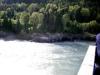
Whirlpools and eddies from the viewing station along the Kitselas Canyon walking tour.
Whale Pole
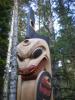
Totem poles at Kitselas Canyon representing Killer Whale clan. Carved by Stan Beven
Eagle and Raven Poles
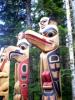
Totem poles at Kitselas Canyon representing the four clans of the Gitselasu; the Wolf, the Eagle, the Raven and the Killer Whale. Carved by Stan Beven