Date: 1966
Name(s): De Menil, Adelaide
Description: Various figures at the base of totems. The original totem poles were carved many years ago at a site on nearby Tuxekan Island where a large Tlingit settlement once existed. Later, around the 1930s, copies of those totems were re-carved by unemployed master boat builders in Klawock through the Civilian Conservation Corps (CCC), a public work relief program.
Date: 1967
Name(s): De Menil, Adelaide
Description: Located at the mouth of Knight Inlet, between the north east coast of Vancouver Island and the mainland, the Mamalilikala band have inhabited this site for centuries. Mimkwamlis was once the largest village on the coast and it is also where the government and First Nations met head to head in a crushing blow to potlatching in December 1921.
Date: 1966
Name(s): De Menil, Adelaide
Description: When standing, this pole showed a human figure with crossed arms wearing a frog hat. Below is Gonakadet, and what appears to be a child, holding a whale. The bottom figure looks like a wolf or possibly a Sea Grizzly.
Date: 1967
Name(s): De Menil, Adelaide
Description: Face carved in the base of a totem pole.
Date: 1966
Name(s): De Menil, Adelaide
Description: Prince of Wales Island, Alaska.
Date: 1966
Name(s): De Menil, Adelaide
Description: Base of pole with figure that looks part bear part human
Date: 1968
Name(s): De Menil, Adelaide
Description: Poles from Haida Gwaii that were moved to a park near Prince Rupert. The pole in the background originally stood at Tanu.
Date: 1992
Name(s): De Menil, Adelaide
Description: Bottom secition of Nisga'a pole at the Edenburough Museum. The label reads: ""Totem Pole Red cedar carved in about 1855 by Oyea Tait, Nishga group of the Tsimshian people, Angyada village, British Columbia, Canada 1930.291 The pole was carved in memory of a Nishga chief, Tsawit. It is 11.3 meters (37 feet) high and originally stood in front of the house of Tsawit's relatives in Angyada village on the Nass River. In 1929 the pole was purchased from its owner by the Royal Scottish Museum. The…
Date: 1918
Name(s): Shotridge, Louis
Description: This is a detail of the owl from the base of the pole raised by Chief Guxsan.
Date: 1972
Description: Edith Campbell picking huckelberries.The gitxsan name for huckleberries is sim maa'y, meaning ""the real, the true berry"". They are the favored berry for drying as they retain their flavour well, and are easy to roll when dry These scenes of food gathering and processing were initiated in order to record some of the traditional food practices among the Gitxsan and to fill some of the gaps left by earlier anthropologist and cultural observers. The objective was to create colour images of…
Name(s): MacDonald, George F.
Description: Shaman's basketry hat, woven from spruce root, polychromatic design denote geometric design and animal figures.
Date: 1979
Description: The 'Ksan Performance group re-enacting the story of the warrior chief Nehl'xt or 'Nekt at 'Ksan Historical Village. The story takes place at 'Battle Hill© near Gitwangak village. 'Nekt was an aggressive warrior and led many successful raids against neighbouring tribes. He is remembered and celebrated by the Gitxsan people as a powerful and great leader.
Name(s): MacDonald, George F.
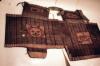
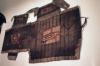
Description: Tlingit battle armour, consisting of slats, rods for flexibility, leather and sinew. Red and black formline adorn the bare panels.
Name(s): MacDonald, George F.
Description: Tlingit battle armour, consisting of slats, rods for flexibility, leather and sinew. Red and black formline adorn the bare panels.
Description: Original photograph of the back of Tlingit battle armour, consisting of slats, rods for flexibility, leather and sinew. The original artifact is housed at St. Petersburg's Museum of Anthropology & Ethnography.