Date: 1968
Name(s): De Menil, Adelaide
Description: A mortuary pole for the remains of the owner of Grizzly Bear's Mouth House. The upper section of the post was fluted, and it originally had a frontal plaque featuring a bear holding a copper.
Date: 1966
Name(s): De Menil, Adelaide
Description: Flying Ground Hog Pole. A 40 ft pole that was recarved, and the flying ground hog at the top was replaced with an eagle.
Date: 1924
Name(s): Barbeau, Marius, 1883-1969
Description: This pole was originally raised by Chief Watakhayetsxw.At the top of the pole is Stikine, and then a Flying-Frog with wings and its head facing down. Next is a large human figure who is sitting with hands raised and palms showing. Next is the Flying-Frog, and at the bottom of the pole is Just-Sticking-Out or Half-Way-Out.
Date: 1966
Name(s): De Menil, Adelaide
Description: Detail of Chief Johnson pole. The pole was commissioned by the Tongass people (sea lion people) and stood in the Centre of the community at Ketchikan Creek. The original pole stood from 1901 to 1982. It was recommissioned in 1989 by the Tongass and carved by Israel Shotridge. The pole tells the legend of Fog Woman and the creation of the salmon. It is a story about a young man (Raven) who took a liking to Fog Woman. He went to fog woman's father's house (chief of the Salmon) and told him he…
Name(s): Duff, Wilson, 1925-1976
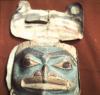
Description: A war helmet with two folding wooden parts with painting, and leather backing. The face is possibly a hawk or eagle transforming.
Date: 1966
Name(s): De Menil, Adelaide
Description: There appears to be two sets of similar house posts. One set is referred to as ""Sitka Bear Post"", while the other is referred to as ""Mother Eagle house post"". The posts are located at the Sitka Natural History Museum, Alaska.
Date: 1966
Name(s): De Menil, Adelaide
Description: There appears to be two sets of similar house posts. One set is referred to as ""Sitka Bear Post"", while the other is referred to as ""Mother Eagle house post"". The posts are located at the Sitka Natural History Museum, Alaska.
Date: 1972
Description: Edith Campbell making hemlock cakes. Plastic is being used to keep the cakes from sticking to the inside of the box. In the old days thimbleberry leaves would have been used. These scenes of food processing were initiated in order to fill some of the gaps left by earlier anthropologist and cultural observers among the Gitxsan. The objective was to create colour images of practices that were partially captured in earlier black and white photographs and in early texts such as those written by…
Date: 1972
Description: Edith Campbell making hemlock cakes. Plastic is being used to keep the cakes from sticking to the inside of the box. In the old days thimbleberry leaves would have been used These scenes of food processing were initiated in order to fill some of the gaps left by earlier anthropologist and cultural observers among the Gitxsan. The objective was to create colour images of practices that were partially captured in earlier black and white photographs and in early texts such as those written by…
Date: 1994
Name(s): Herem, Barry
Description: Detail of crane's wing from Woodworm post. Whale house, Ganaxtedi clan.
Date: 1900 to 1915
Name(s): Newcombe, C. F. (Charles Frederick), 1851-1924
Description: The Fort House was located at the base of Idjao Hill at the south end of Masset. Note how the frontal pole is not only not attached to the frame of the house, but has been separated by a picket fence.
Date: 1911
Name(s): Newcombe, C. F. (Charles Frederick), 1851-1924
Description: Fort House's frontal pole:1. (top) three Watchmen2. Eagle with three small figures between its wings: a young Eagle, a Raven, and a small upside-down human figure3. Bear, holding a human figure in its mouth and with small faces on its paws4. Sea Grizzly with a Seal in its mouth and a Bear between the ears.This pole stood at Skidegate until the 1940's.
Date: 2008
Name(s): MacDonald, George F.
Description: Totem poles at Kitselas Canyon representing the four clans of the Gitselasu; the Wolf, the Eagle, the Raven and the Killer Whale. Carved by Stan Beven
Name(s): Sawyer, Alan R. (Alan Reed), 1919-2002
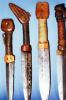
Description: Four daggers with uniquely carved pommels.
Date: 1966
Name(s): De Menil, Adelaide
Description: Looking down a row of totem poles. Hydaburg was established in 1911 by Haida people from three villages. In the 1930s, the Civilian Conservation Corps (CCC) created Hydaburg Park, and several other similar parks in Southeast Alaska. CCC workers brought poles to these parks from other locations. The government then hired local Haida workers to restore these totems. When restoration was not possible, replicas were carved. Twenty-one poles were brought to Hydaburg, five of which were able to be…