Date: 1913
Name(s): Newcombe, C. F. (Charles Frederick), 1851-1924
Description: A set of three carved mortuary poles that still stand on a well-protected curve of beach. It is undoubtedly the most elaborate Haida Mortuary and unlike any other on the islands. A fourth plain post at the back helps to support the burial chamber, which appears to have held the remains of a single individual.
Date: 1932
Name(s): Inverarity, Robert Bruce, 1909-1999
Description: View from behind of a unique and elaborate set of three carved mortuary poles that still stands on a well-protected curve of beach.
Name(s): MacDonald, George F.
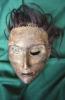
Description: Berlin trophy head.
Name(s): MacDonald, George F.
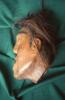
Description: Berlin trophy head.
Name(s): MacDonald, George F.
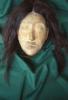
Description: Berlin trophy head.
Name(s): MacDonald, George F.
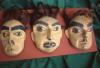
Description: Berlin trophy heads.
Date: 1972
Description: Detail of the top portion of the pole has two human forms of the mythological being, Tsenaanurh, whose name means 'crazy'. Separating the two figures is a Thunderbird.
Date: 1910
Name(s): Lucas, W. W. (William Wrathal)
Description: Tsenaanurh pole and the Grizzly-Bear-of-the-Sea monument of Chief Kantu.
Date: 1967 to 1968
Name(s): De Menil, Adelaide
Description: Detail of the top of the pole, showing the mythological being Tsenaanurh holding a small human that is wearing a crown of what appears to be claws.
Date: 1930
Name(s): Curtis, A.
Description: Depicted three times on the pole, at the top, centre and bottom, is Tsenaanurh, the mythological being by the name of 'crazy', shown in human form. Separating each Tsenaanurh is a Thunderbird.The Tall-Hat pole of Chief Qwaxski'k on the right in the background.
Date: 1968
Name(s): Ochs, Peter
Description: Detail of an owl and Tsenaanurh, the mythological being by the name of 'crazy', shown in human form.
Description: Two soul catchers, one above inlaid with abalone, and of Tsimshian design. Lower one with greater relief carving, of Haida design.
Description: Two soul catchers, one above inlaid with abalone, and of Tsimshian design. Lower one with greater relief carving, of Haida design.
Date: 1966
Name(s): De Menil, Adelaide
Description: One of two totem pole from Metlakatla that were brought to the Sitka Museum in 1888 when a group of young men from Father Duncan's Christian community came to the Sitka Industrial Training School. They were about to burn the poles when Sheldon Jackson arrived to bring the young men to Sitka and asked them to spare the poles and bring them to the museum. Note from unidentified source: In Sheldon Jackson Museum
Name(s): MacDonald, George F.
Description: Full display of Northwest Coast warfare objects, treasures and mannequin donning war equipment. exhibit includes clubs, knives, bows, arrow quivers.